

ISSUE 02 · OCTOBER 2026 · HEALTH
What do we actually know about pesticides and health?
How can many statistical associations coexist with no finding in the review’s strongest evidence class?
An umbrella review maps where observational evidence is more suggestive—and why exposure measurement keeps the conclusion bounded.
Follow the evidence ↓Values reproduce the cited source’s scope; they are not estimates for one field, river, package or person.
01 · BEGIN WITH THE FINDING
A review of reviews
An umbrella review gathers existing meta-analyses and applies a consistent framework to judge their credibility. This one included 53 meta-analyses covering 235 associations between pesticide exposure and health outcomes. Among 77 main associations, 37 were statistically significant and 19 reached highly suggestive or suggestive evidence. None reached the review’s strongest “convincing” class. The map is neither “pesticides cause 235 diseases” nor “there is no concern.”
02 · FOLLOW THE MECHANISM
Exposure is not one thing
“Pesticides” includes different chemicals, uses, doses and routes. Occupational mixing or application is not equivalent to dietary or residential exposure. Studies may use job title, self-report, biomarkers, distance or records as exposure measures; each can misclassify what a person actually encountered. Meta-analysis can pool the studies that exist, but it cannot repair every weakness in their exposure measurement.
03 · KEEP THE CLAIM BOUNDED
Association is a signal to investigate
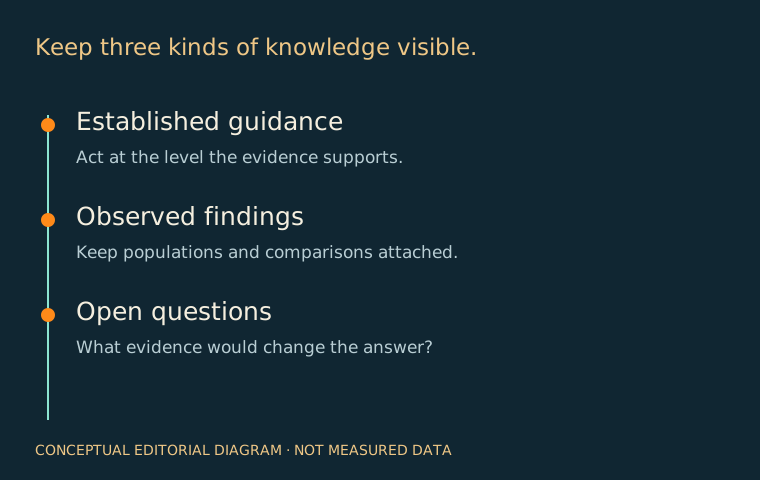
Observational evidence can identify patterns across populations while remaining vulnerable to confounding, heterogeneity and publication bias. Evidence grading asks how consistent, precise and robust those patterns are. The useful public conclusion is specific: some associations warrant serious attention and better exposure research; blanket causal claims across all pesticides and outcomes exceed the review. Prevention and regulation still require chemical-specific evidence and exposure context.
THE EVIDENCE ABOARD
Follow the source.
THE STORY CONTINUES · PASSENGER
The public finding opens the question. The deeper Track tests its limits.
Continue into the study design, system relationships, practical questions and the evidence still missing.
Continue the Passenger investigation →THE ORANGE · FOLLOW THE QUESTION
Ask where it goes next.
The Orange now recognizes this investigation’s vocabulary and routes the question back to reviewed reporting.
Ask The Orange →