

ISSUE 02 · OCTOBER 2026 · PLANET
The label is not the whole material
What does “biodegradable” tell us—and what remains to be tested?
Follow a food-contact material through use, particle release and the end-of-life conditions a label cannot describe alone.
Follow the evidence ↓- 01Raw material
- 02Package
- 03Food contact
- 04Heat / acid / alcohol
- 05Particle release
- 06Collection
- 07Actual end of life
This route explains relationships. It does not depict a measured exposure pathway for one person or place.
01 · BEGIN WITH THE FINDING
A property with conditions
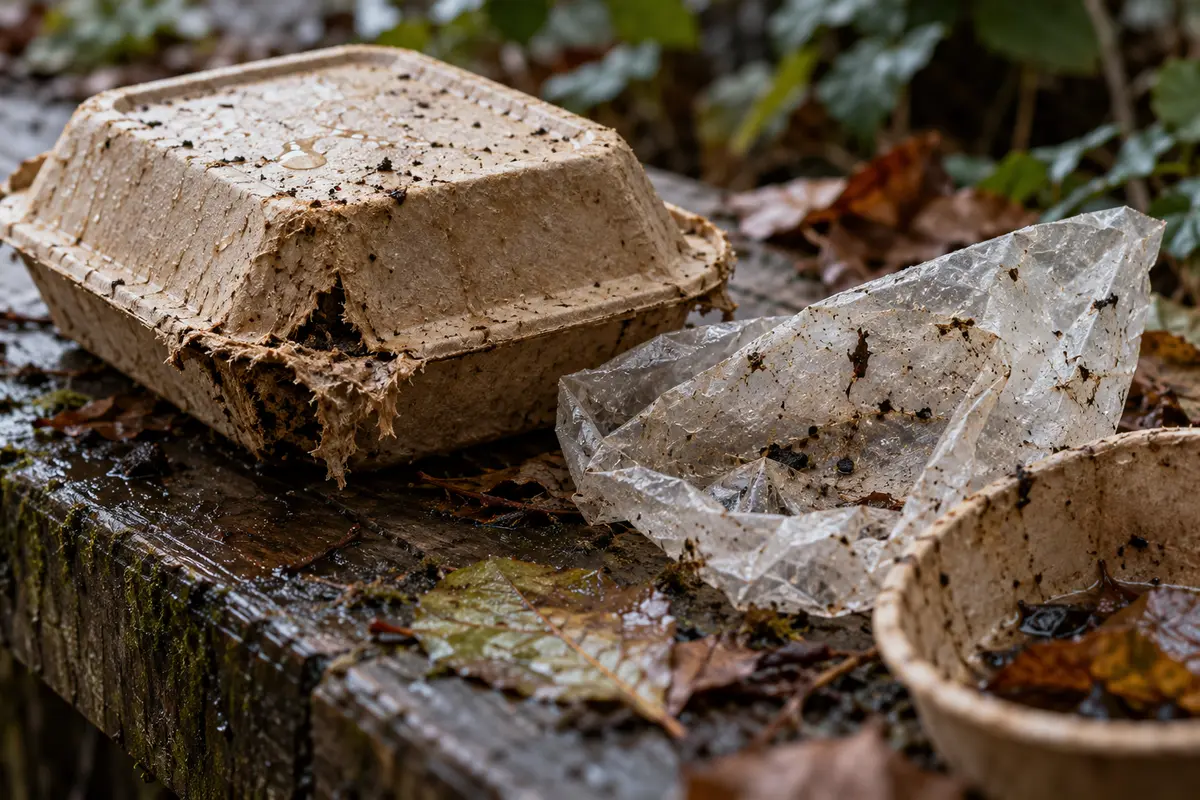
Biodegradable describes how a material can break down under specified biological and environmental conditions. It does not automatically describe food-contact performance, particle shedding, chemical interactions or what happens in a landfill, home compost pile or open water. Those routes have different temperatures, moisture, microbes and time. A responsible comparison asks which exact material, standard and disposal system are involved.
02 · FOLLOW THE MECHANISM
The use phase belongs in the lifecycle
Researchers tested selected biodegradable and conventional food-contact polymers under simulated food-service conditions. In those tests, the biodegradable materials released more micro- and nanoplastic particles, and acidic or alcoholic matrices increased release. The experiment also examined PFOS adsorption to particles. These findings apply to the tested materials and conditions; they do not establish that every biodegradable package performs worse than every conventional one.
03 · KEEP THE CLAIM BOUNDED
A better claim follows the object
A lifecycle judgment must hold several outcomes together: source material, performance during use, food protection and spoilage, collection, processing and environmental fate. A label can be accurate and still incomplete for a decision. The practical questions are precise: Is this item certified for an available composting route? What contact conditions was it designed for? What evidence exists about its use phase? “Green” should open the investigation, not close it.
THE EVIDENCE ABOARD
Follow the source.
THE STORY CONTINUES · PASSENGER
The public finding opens the question. The deeper Track tests its limits.
Continue into the study design, system relationships, practical questions and the evidence still missing.
Continue the Passenger investigation →THE ORANGE · FOLLOW THE QUESTION
Ask where it goes next.
The Orange now recognizes this investigation’s vocabulary and routes the question back to reviewed reporting.
Ask The Orange →