

ISSUE 02 · OCTOBER 2026 · SOIL
Where does the phosphorus go?
If a crop harvests about a quarter of the phosphorus in a global budget, where is the rest?
A crop nutrient can remain in soil, support future growth or move toward water. Efficiency is not the same as runoff.
Follow the evidence ↓Values reproduce the cited source’s scope; they are not estimates for one field, river, package or person.
01 · BEGIN WITH THE FINDING
A finite nutrient with several destinations
Phosphorus is essential to crops and comes partly from mined phosphate rock. The Nature Food analysis estimated average phosphorus-use efficiency near 24–25% for maize, rice and wheat croplands. The measure relates phosphorus harvested in crops to phosphorus inputs in a defined budget. It is a global model, not a claim that every field or every season performs at that average.
02 · FOLLOW THE MECHANISM
Unharvested does not mean downstream
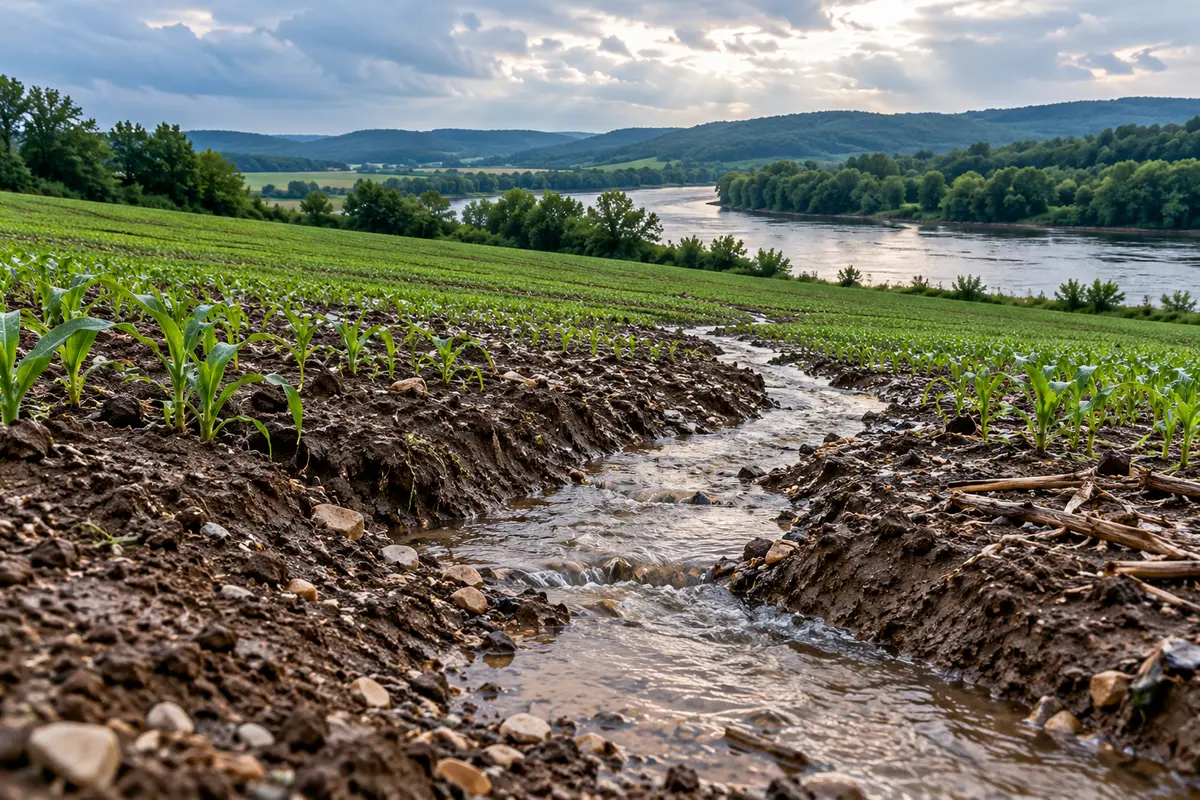
The balance not removed in a crop can be retained in soil, become part of a legacy phosphorus pool, or leave through erosion and runoff under some conditions. Soil chemistry affects how tightly phosphorus is held and how available it remains. A low crop-efficiency number must not be illustrated as three quarters of a fertilizer bag pouring into a river. Local loss requires actual evidence about soil, slope, weather, management and the pathway to water.
03 · KEEP THE CLAIM BOUNDED
The adoption gap is part of the science
After accounting for feasibility constraints, the researchers estimated absolute gains of roughly 5.2 to 6.0 percentage points. Technical potential was larger. The difference is where policy and farm reality enter: equipment, knowledge, fertilizer form, cropping system, capital and risk can keep an agronomic option from becoming an adopted practice. “We know what can help” is not the same as “a grower can safely afford to do it.”
THE EVIDENCE ABOARD
Follow the source.
THE STORY CONTINUES · PASSENGER
The public finding opens the question. The deeper Track tests its limits.
Continue into the study design, system relationships, practical questions and the evidence still missing.
Continue the Passenger investigation →THE ORANGE · FOLLOW THE QUESTION
Ask where it goes next.
The Orange now recognizes this investigation’s vocabulary and routes the question back to reviewed reporting.
Ask The Orange →