


PEOPLE · TOMORROW · THE FOUNDATION
The next world
begins with
a question.
Sir Patrick Stewart, Star Trek and the curiosity that carries us beyond the familiar.
Open a new world ↓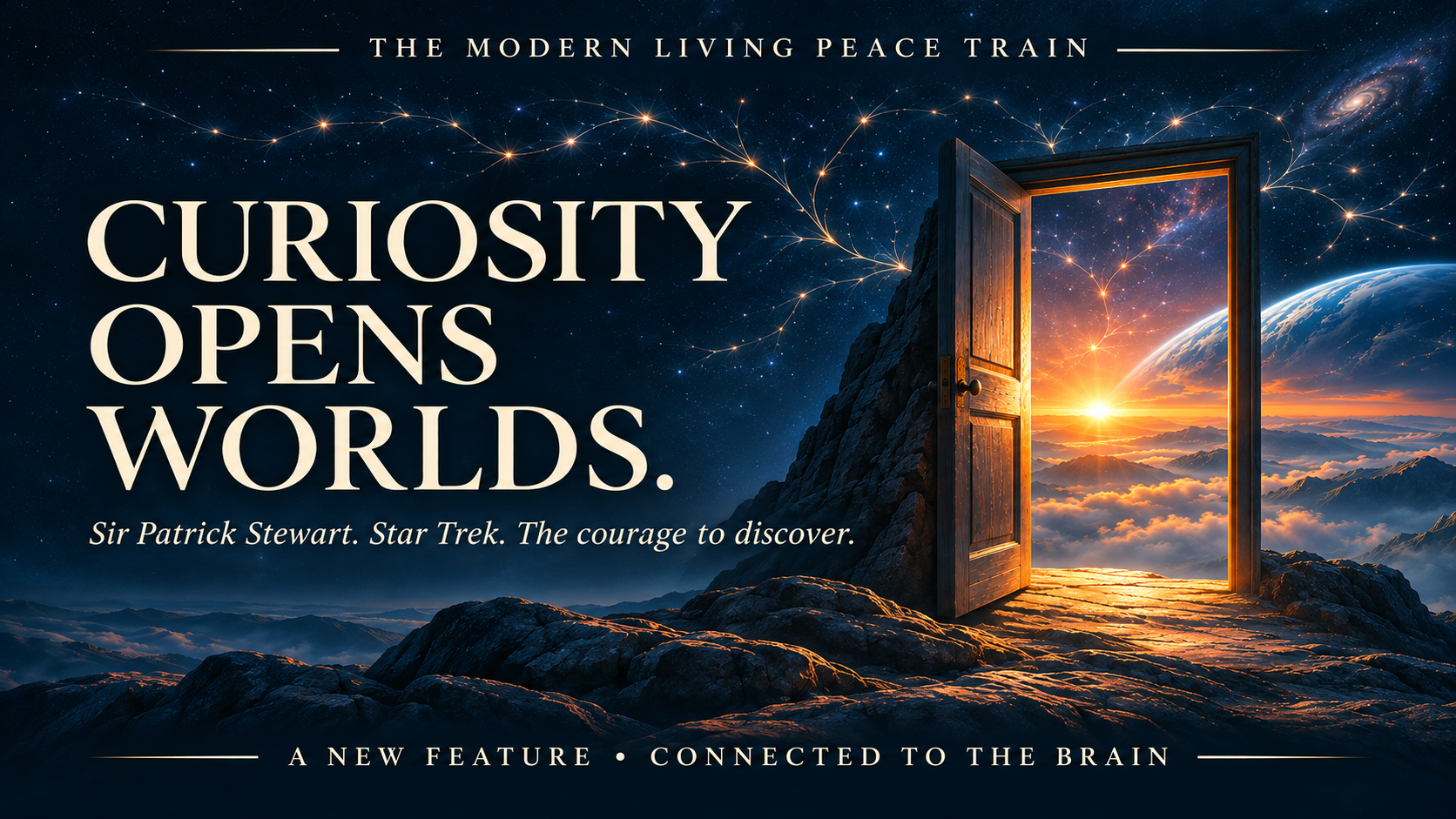
01 / THE INVITATION
Before we can explore a world,
we have to imagine entering it.
A familiar room. A screen. Somewhere beyond it, a starship approaches something no one aboard can yet explain. The important moment is not the arrival. It is the decision to investigate.
For many viewers, Sir Patrick Stewart’s Jean-Luc Picard gave that decision a human shape: composed but not incurious, principled but still capable of being challenged. His captain could command a ship. More interestingly, he could listen to someone whose experience did not fit his own.
That is the legacy we want to follow here. Not a promise that the future will be easy, and not the comforting idea that intelligence will solve everything. A willingness to meet the unfamiliar with attention before judgment.
Following Stewart’s death in October 2026, there are many ways to remember an actor whose work reached far beyond one role. This is an appreciation of one particular gift: helping make exploration feel like a responsibility we could share. Reporting on his life and death ↗
02 / A FICTIONAL CAPTAIN. REAL POSSIBILITIES.
Sometimes the first instrument
of discovery is a story.
Stewart and Picard are not interchangeable. One was an actor bringing intelligence, vulnerability and authority to a performance; the other a fictional captain, written and shaped by many creative people. Star Trek’s achievement belongs to that wider collaboration.
But a performance can make an idea feel inhabitable. In his 2018 statement announcing his return to the role, Stewart described meeting people who told him Picard had inspired them to pursue science, exploration or leadership. That is testimony about influence, not a count of careers a television series caused. It is still a remarkable account of what a character can offer: a possible self. Read Stewart’s statement in Star Trek’s official account ↗
NASA has documented that connection from the other side of the screen. Its account of Star Trek’s influence on planet hunters includes astrophysicist Aki Roberge’s experience of the series as an inspiration. The imaginary voyage and the scientific one are different enterprises. The bridge between them is a person deciding that an unanswered question is worth a working life. Follow NASA’s account ↗
03 / DISCOVERY NEEDS HUMILITY
A new world is not always a new planet.
Sometimes it is another person’s meaning.
In Darmok, Picard encounters a language whose familiar words do not provide familiar understanding. The difficulty is not solved by speaking louder. Shared experience and attention to another culture become essential.
We read that story as a useful challenge to our own habits. Understanding is not the same as recognizing the vocabulary. A person, a place or a living system can remain unfamiliar long after we have learned its name.
Star Trek’s future is worth exploring not because every character gets everything right, but because difference, cooperation and ethical responsibility remain questions that matter. Curiosity without humility can become possession. Exploration without care can become extraction.
Explore the official reflection on Picard and Darmok ↗MAKE THE CONNECTIONS / THE BRAIN
The universe outside.
The world within.
Every act of discovery also asks something of the mind doing the discovering: attend, learn, remember, reconsider. This is where our cultural journey meets The Brain, without turning a television story into a medical claim.
A 2014 laboratory study by Matthias Gruber and colleagues found that higher-curiosity states were associated with better memory for trivia answers and for incidental faces encountered during learning. Brain-imaging results linked these states with activity in systems involved in motivation and memory. The experiment offers a specific window into curiosity and learning, not a verdict on how to live or a guarantee of lasting brain health. Read the original study record ↗
It did not show that watching Star Trek prevents dementia, that curiosity treats Alzheimer’s disease, or that an individual’s illness reflects a failure to stay engaged. Those are not claims we make.
Our broader Brain journey asks how a brain lives within a body, a community and an environment. Evidence, uncertainty and care belong in that conversation together. Curiosity opens the inquiry. It does not excuse us from checking what we find.
Enter The Brain Is Not an Island →Begin with the public opening; the deeper Passenger journey continues within The Foundation.
04 / BRING THE VOYAGE HOME
You do not need a starship.
Take one familiar thing and refuse, briefly, to regard it as finished knowledge. The orange on the counter. The water leaving a field. The neighbor whose conclusion differs from yours.
Ask where it came from. Ask what you have not noticed. Ask which evidence would change your mind. Then follow one answer far enough to meet a better question.
This is not a substitute for scientific work. It is an invitation to pay attention to it, and to the people and places it concerns. We can admire the imagined future while doing something useful in the actual present.
Perhaps that is the most generous way to carry this part of Stewart’s work forward. Not by pretending we already know the destination. By becoming people willing to discover it.
YOUR NEXT DEPARTURE
Come aboard.
Bring your questions.
The world is not finished revealing itself.