


IOWA · FOOD · AN OCTOBER INVESTIGATION
What happens when not enough arrives?
What happens when not enough arrives—in a place that grows so much?
Reporting reviewed October 1, 2026 · Public reporting with four deeper Passenger continuations.

01 · FOLLOW THE QUESTION
An abundant landscape is not yet a reachable meal.
A field can be full while a household budget is running out. Those two conditions do not contradict each other. They describe different parts of the journey: the capacity to produce a crop, and the resources needed to turn food into a meal someone can reliably eat. Iowa makes that distance visible.
In its January 2026 summary of the 2025 harvest, USDA estimated Iowa corn production at 2.772 billion bushels and soybean production at 595.63 million bushels. These are dated crop estimates, subject to revision—not a final count of the 2026 harvest, and not a count of meals. Meanwhile, USDA’s household survey estimated that 10.8% of Iowa households experienced food insecurity in the pooled 2022–2024 period. A harvest measures output. That survey measures constraints on access.
The question is not why farmers have failed to grow enough. Nor is it why households have failed to choose correctly. It is what happens between a productive landscape and a kitchen: prices, earnings, transport, storage, time, buyers and the institutions that connect them.
Evidence: USDA NASS ↘ USDA ERS ↘ USDA ERS ↘
HOUSEHOLDS · 2022–2024 THREE-YEAR AVERAGE
A harvest cannot answer this question.
Share of households experiencing food insecurity. Iowa and the U.S. use the same pooled period.
Common visual scale: 0–20%. The bars show point estimates; uncertainty is stated numerically. Household denominator, not people. Not a daily hunger count. USDA ERS, table 4 ↓
02 · FOLLOW THE QUESTION
Why corn and soy become the landscape.
A commodity farm does not begin every spring with a blank menu. Crops fit an existing system of agronomy, machinery, storage, insurance, elevators, processors and buyers. National demand for livestock feed, ethanol and exports supports corn markets. Soybeans move into crushing plants or export channels; crushing separates protein-rich meal from oil. Meal largely serves animal feeding, while oil has food and fuel uses.
This is an explanation of markets, not an endorsement of every outcome. A grower can face low margins even when a processor or consumer depends on the harvest. Changing the crop without changing the purchasing relationship can simply move the risk onto that grower. A field of lettuce needs a route to people who will buy lettuce at the right time, in the right quantities, at a price that covers the work.
China is an important soybean market in USDA’s national account. It is not the destination for all Iowa production, and it is not a substitute explanation for domestic feed or fuel demand. This reporting does not trace particular Iowa loads to foreign ports. National market patterns cannot identify the buyer of an individual farm’s crop.
Evidence: USDA ERS ↘ USDA ERS ↘
03 · FOLLOW THE QUESTION
Food access has a geography—and a clock.
A nourishing meal has to arrive within the household’s actual day. A low shelf price is less useful if getting to that shelf requires a car someone does not have. A bag of ingredients is not the same opportunity for a household with a working stove, refrigerator and predictable evening as it is for someone living with unreliable equipment or a changing shift. These are questions to document, not character judgments.
Food insecurity is also not a shorthand for being hungry every minute. USDA distinguishes reduced quality and variety from the more severe condition in which eating patterns are disrupted and intake falls. In the same 2022–2024 Iowa estimate, very low food security affected 3.9% of households. The categories describe reported resource constraints; they cannot diagnose an individual’s health or describe every neighborhood.
The statewide average can orient us, but it cannot tell us which town lacks a dependable produce outlet, whose bus journey takes too long, or whether a particular pantry offers culturally familiar food. Those questions require local observation and household participation. We have not manufactured interviews to close that gap.
Evidence: USDA ERS ↘ USDA ERS ↘
04 · FOLLOW THE QUESTION
A pizza, an apple—and an honest comparison.
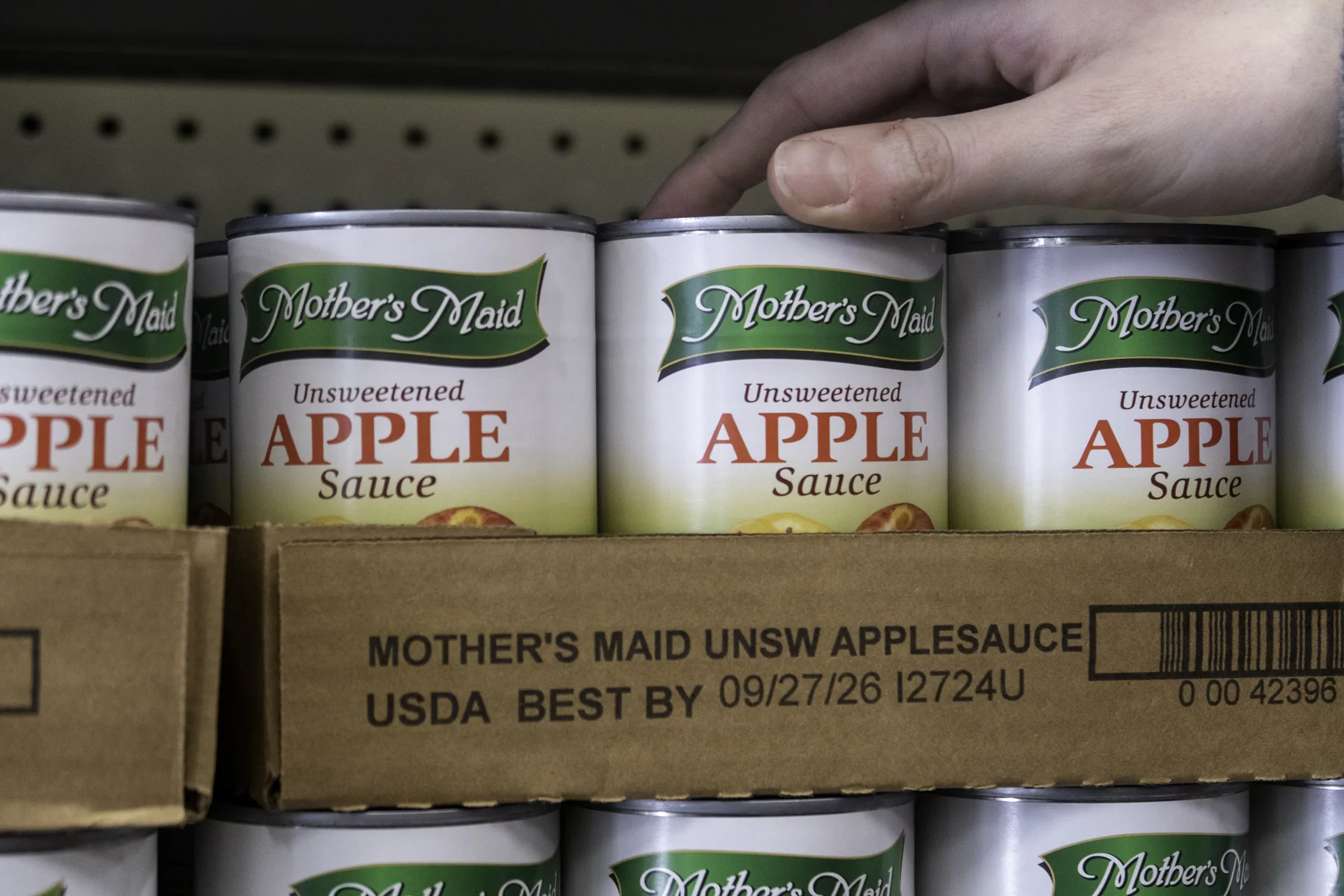
The Founder’s observation is an arresting entrance: an inexpensive frozen pizza beside an expensive apple. It is not yet a documented local price study. We do not have that receipt, package label, store location or date. The comparison below uses an identified retailer listing and USDA’s national produce benchmarks, with their different dates and units kept visible.
The pizza listing is $1.97 for a 9.8-ounce package. The manufacturer calls half the pizza one serving. USDA’s 2023 national estimate for fresh apples is $0.50 per edible cup equivalent—not per whole apple. Neither number establishes what a shopper in Iowa pays today. Neither makes a half pizza and a cup of apple nutritionally interchangeable.
The useful question is broader than which item wins at the register. What does each purchase provide? How much preparation does it require? What can be stored? How much might spoil? What else is needed to make a satisfying meal? A comparison should reveal these constraints rather than use them to shame a choice.
Evidence: Walmart ↘ Totino’s ↘ USDA ERS ↘ USDA ERS ↘
Open the documented comparison →05 · FOLLOW THE QUESTION
Public money takes more than one track.
Commodity income support, subsidized crop insurance, nutrition assistance and produce incentives have different recipients and different rules. ARC and PLC are farm programs with program-specific payment triggers. Insurance helps manage agricultural risk. Nutrition incentives can help participating households purchase fruits and vegetables. These are not interchangeable categories.
An inexpensive frozen pizza does not demonstrate a direct government payment to that product. There can be upstream relationships between farm policy, production, commodity markets and ingredient costs. Establishing the effect on a particular retail price would require a counterfactual analysis through processing, transport, labor, margins and competition. This package does not pretend to have that estimate.
Look for the recipient, the trigger and the intended outcome. Then ask which costs remain outside the program. A payment that stabilizes farm revenue can be valuable without solving a household’s transport problem. An incentive that increases purchasing power can be valuable without creating a local growing or distribution business.
Evidence: USDA FSA ↘ USDA RMA ↘ USDA NIFA ↘ USDA NIFA ↘
Follow the harvest and the public dollar →06 · FOLLOW THE QUESTION
Health belongs here. Certainty does not come free.
Food access and dietary quality are related questions, but they are not the same measure. A meaningful evaluation might track household food security, fruit and vegetable intake, or a specified clinical outcome in an appropriate study. USDA’s produce-prescription guidance requires measurement across food security, diet and health-care use or cost; those evaluation goals are not themselves proof of improved health.
Marketing belongs in the conditions surrounding choice. The FTC documented food-company promotional activity directed toward children in historical national data. The Rudd Center separately examined advertising directed toward Black and Hispanic audiences. Neither report measures current exposure in an Iowa household. Race and ethnicity must not be treated as substitutes for income, and a marketing pattern does not prove why a particular person bought a particular food.
We do not claim that a food’s having once been alive makes it harmful. We do not present “vibratory wellness” as a measured biological mechanism. Nor can a country’s life expectancy be attributed to diet alone. The health question deserves evidence that identifies an outcome, a population and a design capable of supporting the claim.
Evidence: USDA NIFA ↘ U.S. Federal Trade Commission ↘ UConn Rudd Center ↘
07 · FOLLOW THE QUESTION
What would make both ends of the journey stronger?
Iowa already grows vegetables. The next question is not whether it can begin from nothing, but where more production would be viable and where it would improve access. Seasonal high tunnels, reliable institutional buyers, produce incentives and distribution can address different breaks in the connection. None is a universal fix.
A protected crop still needs workers, water, food-safety practices, a harvest schedule and paying buyers. A purchasing commitment still needs a fair specification and a payment timetable. An incentive still needs an accessible participating outlet. A stronger system connects these pieces without asking farmers or households to absorb every uncertainty.
Begin with a reachable improvement. Name the people it is meant to help. Cost the work. Specify what will be measured. Keep a way to change direction when the evidence disappoints. Enough is not simply more arriving somewhere. It is useful nourishment arriving reliably, with a livelihood behind it.
Evidence: Iowa State University Extension ↘ USDA NRCS ↘ Iowa Department of Agriculture ↘
Compare practical alternatives →THE STORY CONTINUES · PASSENGER
A meal has a total cost
What changes when time, transport, storage and uncertainty join the price?
Continue into the deeper reporting →The public reporting above remains free to read. Protected continuations use the existing Passenger access check.
FOLLOW THE RESEARCH
Evidence, dates and limits.
- USDA NASS · Crop Production 2025 Summary, January 12, 2026 ↗
Dated Iowa harvest estimate; later revisions are possible.
- USDA ERS · Household Food Security in the United States in 2024, table 4 ↗
Iowa and U.S. 2022–2024 household averages; 90% confidence margins.
- USDA ERS · Definitions of food security ↗
Survey categories describe access to adequate food, not individual diagnoses.
- USDA ERS · Feed grains sector at a glance ↗
National markets and uses, not a trace of a particular Iowa shipment.
- USDA ERS · Oil crops sector at a glance ↗
Soybean crushing, meal, oil and trade destinations.
- Walmart · Totino’s Triple Cheese Party Pizza, 9.8 oz ↗
Retrieved October 1, 2026 from an indexed listing; crawl roughly three months old. Location and checkout price not verified.
- Totino’s · Triple Cheese Party Pizza product and nutrition label ↗
Two half-pizza servings; actual package label can change.
- USDA ERS · Fruit and vegetable prices, 2023 data ↗
National retail benchmarks, published July 31, 2026; not local October prices.
- USDA ERS · Fruit and vegetable price documentation ↗
Edible cup equivalents, yield factors and national scanner-price methodology.
- USDA FSA · Agriculture Risk Coverage and Price Loss Coverage ↗
Farm income support with program-specific eligibility and triggers.
- USDA RMA · Enhanced Coverage Option ↗
Insurance coverage and public premium support; not a grocery discount.
- USDA NIFA · Gus Schumacher Nutrition Incentive Program ↗
Nutrition incentives and produce prescriptions are distinct grant streams.
- USDA NIFA · GusNIP SNAP/NAP policy ↗
Incentives support participant purchases; not retailer inventory subsidies.
- USDA NIFA · Produce Prescription Program FAQ ↗
Required evaluation domains are goals to measure, not proof of clinical success.
- U.S. Federal Trade Commission · Food marketing to children follow-up, 2012 ↗
Historical national company data on 2009 marketing, not current Iowa exposure.
- UConn Rudd Center · Targeted food and beverage marketing report, 2022 ↗
Race/ethnicity-targeted advertising analysis; race is not a proxy for income.
- Iowa State University Extension · Growing leafy greens in Iowa ↗
Cool-season crop suitability and planting windows; not a commercial profitability forecast.
- USDA NRCS · EQIP High Tunnel Initiative ↗
Season-extension structures and assistance; eligibility is not automatic.
- Iowa Department of Agriculture · Local Food Purchasing Assistance, May 10, 2023 ↗
Historical purchasing initiative, announced through May 2025. Current successor funding not verified.
Material gaps: no verified Founder receipt or current local price pair; no farm-specific greenhouse quotes or audited conversion budget; no traced Iowa-to-China shipment series; no verified successor funding for the historical local purchasing initiative. These limits are not filled with invented evidence.