


UNDER GLASS · A COMPANION INVESTIGATION
← Return to the anchor investigationIf we can grow flowers under glass, what would it take to grow more food?
Iowa already grows vegetables. Expanding the harvest means matching shelter, seasons, labor and buyers—not simply changing what sits inside a greenhouse.
Reporting reviewed October 1, 2026 · Public reporting with four deeper Passenger continuations.
01 · FOLLOW THE QUESTION
There is already a beginning.
Iowa State Extension describes lettuce, spinach, kale and other leafy greens as crops suited to cool conditions, with spring and fall planting opportunities. That matters: the question is how to extend or improve an existing possibility, not how to introduce vegetables to a state that has never grown them. A garden planting guide establishes crop suitability; it does not establish a commercial profit.
Nor is an ornamental greenhouse an empty shell waiting for a better use. Flowers may have committed customers, established workers and a seasonal revenue plan. Converting space has an opportunity cost. Before proposing a switch, ask what the current operation produces, when the space is occupied and which contracts or skills would be displaced. We have no audited Iowa ornamental-business conversion budget to claim otherwise.
Evidence: Iowa State University Extension ↘ Iowa State University Extension ↘
02 · FOLLOW THE QUESTION
A tunnel is not a heated greenhouse.
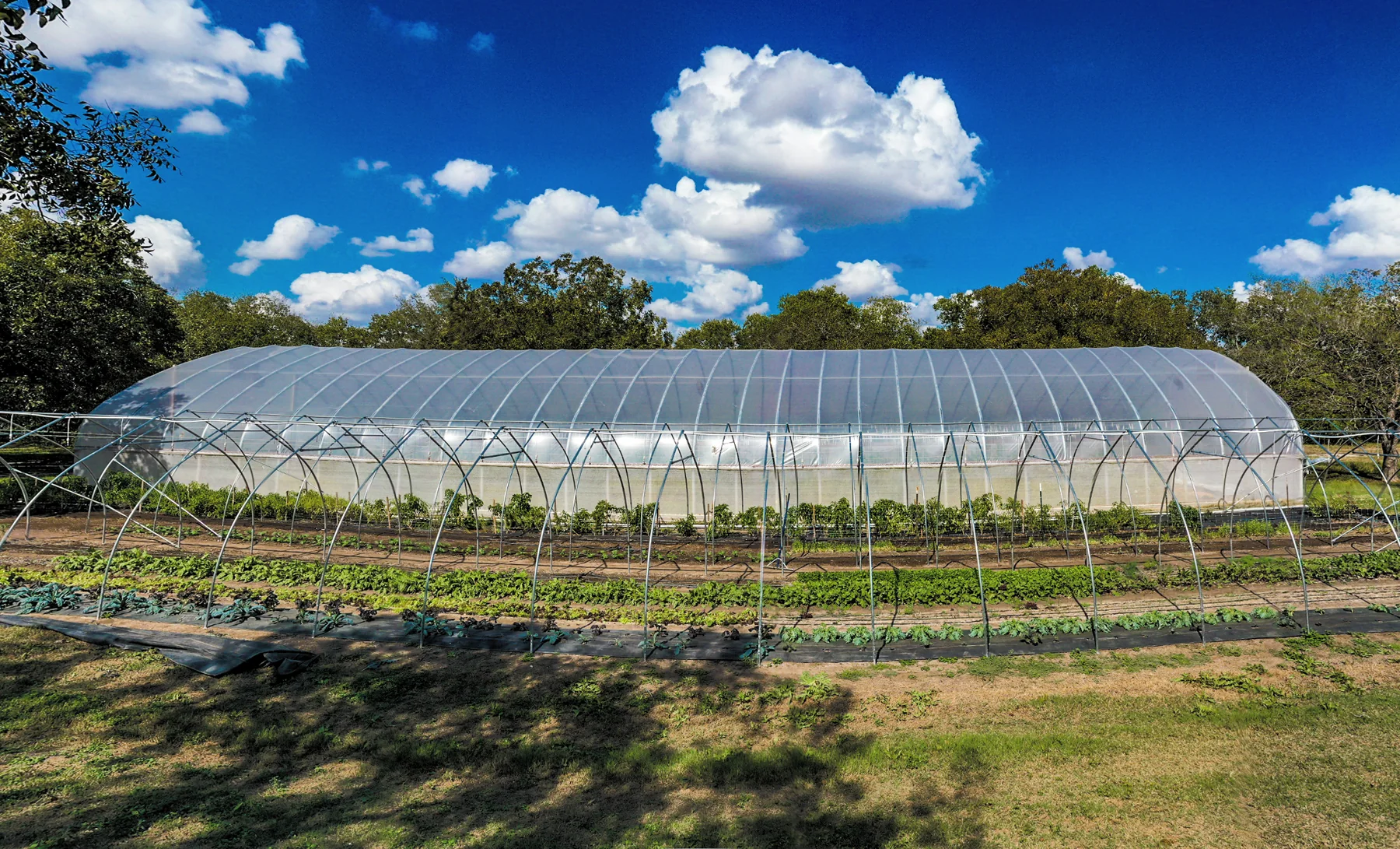
A seasonal high tunnel is a covered growing environment used to extend the season and shelter crops. A heated greenhouse adds an active temperature-control commitment. The structures can share protective functions while creating very different capital, energy and management requirements. “Under cover” does not identify a single business model.
Shelter can reduce exposure to rain and weather, but it does not manufacture winter daylight. A lettuce crop still needs enough light to grow; supplemental lighting would add equipment and electricity rather than make that limitation disappear. Cold-tolerant greens, transplant timing and a seasonal sales window may offer a different strategy from maintaining summer-like conditions all winter.
NRCS’s high-tunnel initiative offers assistance through EQIP to eligible producers. Assistance can reduce an investment barrier; it cannot supply a profitable buyer or guarantee eligibility. A proposal should separate the initial structure, ongoing operating costs and expected sales instead of calling the whole operation “subsidized food.”
Evidence: USDA NRCS ↘ Iowa State University Extension ↘
03 · FOLLOW THE QUESTION
Heat has to earn its place.
A SARE-supported Ohio farm trial compared winter greens with and without supplemental heat. It is useful because it investigated real growing conditions rather than an imagined year-round yield. It is limited because weather, crop response, incomplete observations and farm-specific practices affect the result. It is not an Iowa forecast.
The project report also contains a cost comparison whose wording conflicts with the displayed direction of the cost figures. We do not reproduce that sentence as a proven saving or turn it into a precise Iowa return-on-investment chart. The stronger lesson is methodological: record fuel, marketable yield, cover-management labor and sale timing together.
For a new operation, obtain current quotes for the structure, installation, fuel, electricity, water and labor. Identify the crop cycle, the likely marketable share and the harvest price. Then test the result against colder weather, lower prices and delayed sales. If the proposal works only when every assumption is favorable, its risk is being hidden rather than solved.
Evidence: SARE ↘ Iowa State University Extension ↘
04 · FOLLOW THE QUESTION
The crop still has to travel.
Leafy greens require harvesting, appropriate handling and a route to buyers while quality holds. Washing and packing practices, water quality and food-safety responsibilities belong in the plan from the start. FDA’s agricultural-water guidance applies to covered farms and explains risk assessment around relevant water uses; a roof is not a food-safety exemption.
The buyer might be a grocery outlet, a school, a meal provider or a direct household customer. Each requires a different volume, specification, delivery schedule and price. An institutional contract can reduce uncertainty, but only if its commitments are real and its payment terms are workable for the grower.
A practical expansion could begin with a seasonal crop and a known purchasing window. A larger heated operation could be appropriate elsewhere. The choice should follow the crop, the site, the budget and the buyer—not the visual appeal of glass.
Evidence: FDA ↘ Iowa Department of Agriculture ↘
05 · FOLLOW THE QUESTION
Flowers and food do not need a false contest.
The original question opens a useful possibility. It becomes stronger when we remove the assumption that one form of cultivation is wasteful and the other automatically serves everyone. The same household can value flowers and need better food access. The same business can possess transferable skills while lacking suitable equipment or customers for a different crop.
A fair experiment would protect livelihoods while learning: cost a limited production block, identify dependable purchasers, document marketable harvest and labor, and evaluate who can actually obtain the food. Success is not simply produce growing behind a transparent wall. It is a viable growing operation connected to people who benefit from its harvest.
Evidence: Iowa State University Extension ↘ Iowa State University Extension ↘
THE STORY CONTINUES · PASSENGER
A different crop needs a different system
What must change before diversification can become a livelihood?
Continue into the deeper reporting →The public reporting above remains free to read. Protected continuations use the existing Passenger access check.
FOLLOW THE RESEARCH
Evidence, dates and limits.
- Iowa State University Extension · Growing leafy greens in Iowa ↗
Cool-season crop suitability and planting windows; not a commercial profitability forecast.
- Iowa State University Extension · Vegetable production budgets ↗
August 2022 planning templates; replace assumptions with actual farm quotes.
- USDA NRCS · EQIP High Tunnel Initiative ↗
Season-extension structures and assistance; eligibility is not automatic.
- SARE · Winter production of greens: supplemental heat trial FNC21-1277 ↗
Ohio on-farm trial; context and incomplete observations limit transfer to Iowa.
- FDA · Agricultural water requirements under the Produce Safety Rule ↗
Requirements for covered farms; crop contact and water hazards matter.
- Iowa Department of Agriculture · Local Food Purchasing Assistance, May 10, 2023 ↗
Historical purchasing initiative, announced through May 2025. Current successor funding not verified.
Material gaps: no verified Founder receipt or current local price pair; no farm-specific greenhouse quotes or audited conversion budget; no traced Iowa-to-China shipment series; no verified successor funding for the historical local purchasing initiative. These limits are not filled with invented evidence.